Does the Average American Deserve Citizenship?
I'm just being provocative

Curdling beneath the public debates over American foreign policy is a much larger question: shall we continue down the path of empire, or restore the republic? I seek to address an underlying question that will determine whether a return to the republic is possible for Americans: are Americans even fit to be citizens?
Empires and Republics are in Opposition to One Another
It is necessary to demonstrate that empires and republics are mutually exclusive. Obviously, the Roman republic had conquered a significant amount of territory even before the reign of Caesar. However, this was often to the detriment of Roman citizens. The amount of treasure and blood required to maintain these territories caused much civil strife. The Roman citizen may have had more interesting trinkets and diverse goods than before the expansion of Rome (and often not even that), but at the great cost of their own liberty. The history of the Gracchi brother is evidence of this. A republic depends on unity, respect for your superiors, and reverence for the law. Empires must bring in immigrants in order to have enough bodies to throw at the various wars they are fighting, which destroys unity. The merchants become wealthy and purchase political power, which undermines respect for political positions. Both of these factors contribute to the desecration of the law.
Americans are clearly in a similar position. The expansion of our state across this continent was natural and good, but we did not stop there. Our first real imperial experiment began in the east. Our control of the Philippines was granted to us after our victory in the Spanish-American war, and it quickly became contentious. We eventually permitted Philippine independence, but this is not where the story ends. Territories in Central America were also granted to the USA after the Spanish-American war, and our military was used to establish order and safe trade-routes in South America. I too would fight many a battle to ensure that my steady stream of bananas does not cease to flow. These banana wars ceased when Franklin Roosevelt withdrew from Haiti. FDR, as many understand, transitioned us away from this more natural form of empire into what is often called the Global American Empire.

I will not waste too much time here in explaining how the Global American Empire functions, I will save my thoughts on globalism for another essay. It will suffice to say that the United States maintains this empire through a series of complex financial operations historically rooted in the Bretton-Woods system. By fostering dependence on the US Dollar, the American Empire maintains its hegemony over mature states. The vast power of the American military is stationed all over the world but is generally only used against states which will not financially cooperate, or states who draw the ire of our “greatest ally.”
This global financial system maintains the loyalty of dependent states, but it causes inflationary pressure on the Dollar. Foreign banks are permitted to issue credit denominated in dollars. Bank lending creates about 97% of the money supply.1 Developing countries must be open to foreign investment and participate in free trade in order to receive loans from the World Bank and IMF2. Due to the perceived safety of the US Dollar, entrepreneurs and businesses in third world countries prefer loans denominated in the Dollar, particularly when interest rates are low. When the dollars strengthens, it becomes more difficult for third-worlders to pay these loans back, ensuring that they will remain dependent on the Dollar.3 This is a broad and simplistic overview of the global economy, and I will discuss these points in more detail at a later date.
This global dependence on the US dollar does make it easier for Americans to purchase foreign capital or goods (yummy bananas), but the inflationary pressure is clearly observable. The cost of maintaining this world empire is that the money you earn is worth less and less every day. We have traded affordable homes for cheap bananas. This is the cost of empire. Heritage Americans do not truly reap the benefits of citizenship: American citizenship is cheap, our leaders hate us, and political power can be easily purchased by the highest bidder. A republic cannot embark on an imperial project and remain a republic for long. The cost of maintaining an empire is the inherited wealth and natural rights of the citizens.
Republics are built on the virtues of their citizens, the question at hand is whether Americans are fit to be citizens. By this I mean Heritage Americans exclusively. As many have said of late, a piece of paper does not make you a citizen, citizenship is not merely a legal term. Republics are generally founded by independent, civically minded, and physically capable citizens. The citizen of a republic must be capable of self-sufficiency, civic action, and violence.
Self-Sufficiency
Republics have historically coincided with independent or ancestral wealth. For the citizen of a republic, dependence is slavery. The dependent man will inherently vote or exercise his rights in accordance with whatever he is dependent on. The independently wealthy have the security to pursue legislation that is in accord with virtue for virtue’s sake.
Steadfast republics usually find their wealth in an agrarian citizenry, and citizens are usually slave owners of the classical or Tidewater sort. These sorts of republics are populated by homesteads, where the land is worked by subservient non-citizens and the affairs of the estates are managed by the head of the household. Chattel slavery, on the other hand, is generally not conducive to a republic as the possibility of revolt is too high, and mass slavery is generally only utilized for the mass production of goods to be sold in an international or large national market. Slavery is not a requirement, though agrarian republics tend to have various forms of slavery, often under other names. The head of the household is usually the only citizen, and these rights passed to the eldest son.
In order to more widely disperse the benefits of citizenship, Thomas Jefferson once introduced a bill which eliminated primogeniture and instead permitted the head of the household to distribute his land according to his affections.4 This bill was explicitly introduced to more equally divide the benefits of citizenship among Heritage Americans, and given the open frontier of the American West, it certainly made some sense. Furthermore, it was a preventative measure against the danger of disinherited second sons. Second sons, deprived of inheriting a large estate, were often agents of chaos in historical republics. Plutarch, however, saw that primogeniture was a necessary factor for the maintenance of a republic, as the wanton distribution of land inherently led to the concentration of wealth into the hands of the few.

Mercantile republics, like the Venetians or our Yankees, are often less sturdy, given that they are often reliant on international trade. Nonetheless, mercantile republics tend to have many citizens of independent wealth. On the other hand, mercantile republics are inherently prone to licentiousness and luxury.
I own it to be my opinion, that good will arise from the destruction of our credit. I see nothing else which can restrain our disposition to luxury, and to the change of those manners which alone can preserve republican government. As it is impossible to prevent credit, the best way would be to cure its ill effects, by giving an instantaneous recovery to the creditor. This would be reducing purchases on credit to purchases for ready money. A man would then see a prison painted on everything he wished, but had not ready money to pay for.
-Thomas Jefferson
The United States contained both forms of republics at its inception, as the Federalists understood. In creating a union of these republics, they hoped to ease the excesses of both kinds.

Both sorts of these republics are prone to wealth-concentration. It is clear that wealth-concentration is also destructive to a republic, as the commons will use any means to obtain a share of that wealth if it is not granted to them by legitimate means.
I maintain that the ambition of the great is so pernicious that unless controlled and counteracted in a variety of ways, it will always reduce a city to speedy ruin. So that if the controversy over the Agrarian Laws took three hundred years to bring Rome to slavery, she would in all likelihood have been brought to slavery in a far shorter time, had not the commons, by means of this law, and by other demands, constantly restrained the ambition of the nobles.5
In attempting to restore the Spartan republic to its former glory, (the founders claimed that Sparta was a republic6) Plutarch tells how both Agis and Cleomenes drew the ire of the wealthy. Plutarch states that Sparta fell into corruption with the conquest of Athens and the resulting influx of silver and gold (contrary to the laws of Lycurgus). The law nonetheless remained uncorrupted until Epitadeus (on account of a quarrel with his own son) drafted a law that would permit men to have liberty to dispose of their land as they wished. This inevitably led to the concentration of wealth in the hands of the few. As wealth concentrated, Spartan citizens were no longer able to use their time to pursue virtue in leisure. Due to this disparity, Spartan citizens were no longer as dutiful to the defense of their civilization and awaited and opportunity revolt at home.
Such was the battlefield arranged when King Agis came to one of the two Spartan thrones. Agis sought to bring equality back to Sparta and redistribute the land among the Spartans and cancelling debts. Agis was easily able to recruit the young men of Sparta, as they were prepared for change. The older men of Sparta were in opposition to Agis: “These men could not endure to hear Agis continually deploring the present state of Sparta, and wishing she might be restored to her ancient glory.”7 For these attempts, he was put to death by the Ephors. The man responsible for the death of Agis, Leonidas, married Agis’ widow to his own son Cleomenes. Cleomenes succeeded to the throne of Leonidas after his death, and intrigued by Agis’ plan, contrived to bring it into being when the Ephors were weakest. While returning from war, Cleomenes had the Ephors slaughtered. He the seats of the Ephors leaving only one for himself.
if it had been possible for him, without bloodshed, to free Lacedaemon from those foreign plagues, luxury, sumptuosity, debts, and usury, and from those yet more ancient evils, poverty and riches, he should have thought himself the happiest king in the world, to have succeeded, like an expert physician, in curing the diseases of his country without pain. But now, in this necessity, Lycurgus’s example favored his proceedings, who being neither king nor magistrate, but a private man, and aiming at the kingdom, came armed into the market-place, so that king Charillus fled in alarm to the altar. He, being a good man, and a lover of his country, readily concurred in Lycurgus’s designs, and admitted the revolution in the state. But, by his own actions, Lycurgus had nevertheless borne witness that it was difficult to change the government without force and fear, in the use of which he himself, he said, had been so moderate as to do no more than put out of the way those who opposed themselves to Sparta’s happiness and safety.
Plutarch compares Agis and Cleomenes with the Gracchi, and rightly so. All of these men dealt with the same issues wherein the right of citizens of the Republic and the law itself are slowly ground into a fine dust. As wealth concentrates in a republic, poorer citizens are less able to exercise their political rights. You are not able to become a politician without sufficient leisure, and without sufficient funding, one cannot have sufficient leisure. Do not be surprised by revolution when our Ephors continue to prevent the young from inheriting their wealth. The fact that the median age of purchasing a home is now 40 is a significant problem.8 Those citizens who may wish to return to a republic are generally incapable of doing anything about it, those who wish to stay on this imperial path benefit greatly from it and can therefore use these funds to gain more political power. It is clear that real Americans are quickly losing the little self-sufficiency that they had left.
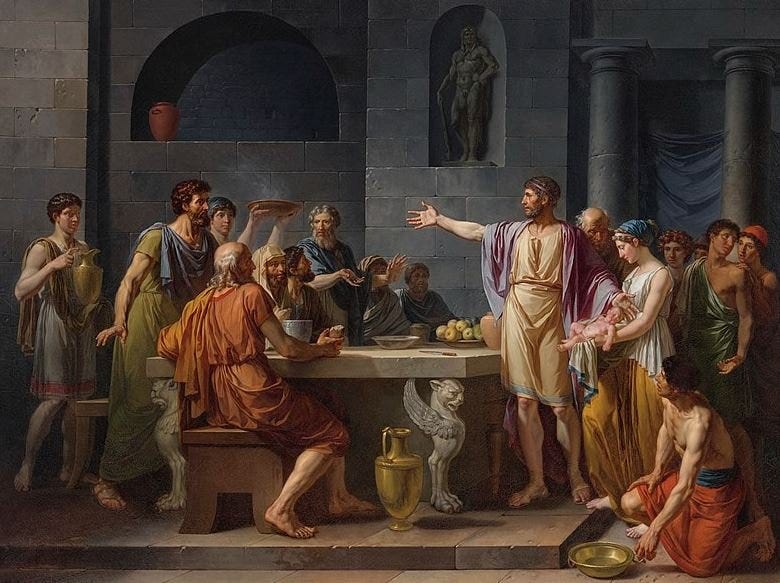
Civic Action
This is a language which has been often used in my presence; and you will readily conceive that, as it furnishes those who argue on the fundamental maxims of a Republican government with ample field for declamation, the conclusion has always been, that you should not decline the service of your country. The present is generally conceived to be an important era, which, of course, makes your attendance particularly necessary. And as I have taken the liberty to give you the public opinion and desire upon this occasion, and as I am warmly interested in whatever concerns the public interest or has relation to you, it will be necessary to add, it is earnestly the desire of, dear Sir9
As stated above, wealth combined with leisure permits a citizen to take political or civic actions. However, civic action must actually be taken. If one has read Robert Putnam’s Bowling Alone they will recognize that American civic engagement has rapidly decreased over the last hundred years or so. This trend began with the Boomer generation but has continued unthwarted. Given that technology is partially responsible for this trend, it is unlikely Zoomers or Alphas will be any better. Furthermore, the amount of time people have to engage in these activities is certainly decreasing. The number of Americans working one full-time job and one part-time job is at an all-time high; the number of Americans working two full-time jobs has also reached a historic peak.10 Wages have not nearly kept pace with inflation, particularly for housing costs, which has led many Americans to run multiple “side-hustles” in order to keep pace with growing demands.11 Furthermore, due to the demands of living in a “multicultural” society, the average American’s commute is 28 minutes one way, further limiting the amount of time Americans have for getting politically involved.
One of the less-discussed aspects of bio-Leninism is the amount of time degenerates have. While you are working hard to support a family, purchase a home, and donate to your church, the degenerate has all the time in the world to make noise publicly and online. If they are stealing your money (through welfare) and using their leisure time for activism, your leisure has literally been transferred to your enemy to further destroy your civilization. Furthermore, if you don’t mind living in a polycule household and splitting rent, you can take a poorly paying job as an activist and get paid with government grant money. This government-funded transfer of leisure prevents the well-adjusted from finding the necessary time to become involved in civil action. It is impossible to get involved in governance without leisure:
With a positive duration of considerable extent, I connect the circumstance of re-eligibility. The first is necessary to give to the officer himself the inclination and the resolution to act his part well, and to the community time and leisure to observe the tendency of his measures, and thence to form an experimental estimate of their merits12
Our system, which destroys ancestral wealth through taxation, usury, and nomadism; further limits the capacity of the American to participate in politics. The average American inherits around $46,200.13 Given that most Americans do not have the safety that family land provides, they are unable to truly be citizens.
[O]ne of the greatest and highest blessings Lycurgus procured his people was the abundance of leisure, which proceeded from his forbidding to them the exercise of any mean and mechanical trade. Of the money-making that depends on troublesome going about and seeing people and doing business, they had no need at all in a state where wealth obtained no honor or respect.14
A point that has yet to be addressed is whether Americans are capable of thinking, writing, and speaking well. Addressing any data on this issue is essentially impossible given that we know many teachers simply lie when grading. I will simply ask the reader to listen to people talk when they are next out on the town. It is clear that the average American is not well-read, well-spoken, or literate to any substantial degree. With regard to Civic Action, it is clear that most Americans are not capable of truly acting as citizens.
Violence
And while this is true of individual men, it holds good also of a concourse of men living together in one republic, who will arrive at that measure of perfection which the institutions of their State permit. And although I have already said on another occasion that a good militia is the foundation of all States, and where that is wanting there can neither be good laws, nor aught else that is good, it seems to me not superfluous to say the same again; because in reading this history of Titus Livius the necessity of such a foundation is made apparent in every page. It is likewise shown that no army can be good unless it be thoroughly trained and exercised, and that this can only be the case with an army raised from your own subjects. For as a State is not and cannot always be at war, you must have opportunity to train your army in times of peace; but this, having regard to the cost, you can only have in respect of your own subjects.15
The stories of Lycurgus, Agis, and Cleomenes demonstrate that violence is a necessary factor for establishing or re-establishing a republic. The United States probably has more militia members than any other country in the world.16 Whether they are willing and/or able to use force is another question entirely. Furthermore, the average American is not a member of the militia. That fact alone may be enough to state that most Americans should not be considered citizens on its face. The judgment must rest, however, on whether most Americans would be capable of defending their homeland if they were called upon to do so. The answer, unfortunately, is no.
U.S. Army recruits are more out of shape now than ever, and around 35% sustain at least one musculoskeletal injury during training.17 While these statistics are slightly skewed by the fact that women account for 62% of these injuries, it is still obvious that most Americans are not fit for active service. The Army spends $100 million annually on Army fitness schools (read this article, seriously, it is absurdly funny).18 Only 23% of Americans 17-24 years old are qualified to serve in the armed forces, and our standards are clearly not high enough anyway.19 Fitness is the bare minimum for an effective fighting force, and the average American does not have even that.

Now, 23% of the American youth are fit for service. About 32% of Americans own a firearm, which is another necessary factor for even having a militia.20 A 2015 survey found that 61% of firearm owners report having received some form of formal firearm training.21 This means that only around 15 million Americans (around 4%) are qualified to participate in any form of legitimate militia. This excludes the process of actually training Americans to operate as a militia. It is absolutely clear that the average American is not fit to be a citizen.
Conclusion
The average American is not independently wealth, civically engaged, and capable of fighting in a militia. If our country is to return to its republican roots, we have two options (both of which require that we deport at least 100 million people, obviously). Option one is that we make more Americans fit to be citizens. Option two is that we restrict citizenship to actual citizens (wealthy, socially active, and able to fight). Neither of these options are easy. It is not clear to me that most Americans are even capable of being citizens, and therefore option one is probably impossible. Option two will certainly cause much strife, but it is the only option that appears feasible to me.
It may be beneficial to hold this article up as a mirror. Are you fit to be a citizen? Are you ensuring that your children will inherit some wealth? Are you using what little leisure you have to engage in the civic process? Are you fit enough to fight when it inevitably breaks down? Do not let the state of things make you complacent. You must be prepared when Caesar or Cleomenes calls upon you.
https://professorwerner.org/blog/
Dollar Milkshake Theory Explained - The Investor’s Podcast
Thomas Jefferson’s autobiography
Discourses on Livy: CHAPTER XXXVII, Machiavelli
FEDERALIST No. 6. Concerning Dangers from Dissensions Between the States, Hamilton
Plutarch’s Parallel Lives
-JAMES MONROE TO THOMAS JEFFERSON. 05/11/1782
https://www.forbes.com/sites/carolinecastrillon/2025/03/24/why-a-record-89-million-americans-are-working-multiple-jobs/
FEDERALIST No. 72. The Same Subject Continued, and Re-Eligibility of the Executive Considered. Hamilton.
https://finance.yahoo.com/news/average-american-inheritance-wealth-level-130120356.html
Plutarch’s Lycurgus
-Machiavelli Discourses on Livy, Chapter XXXI
https://en.wikipedia.org/wiki/List_of_militia_organizations_in_the_United_States
https://www.militarytimes.com/news/your-military/2023/04/03/poor-fitness-among-recruits-is-costing-the-army-millions-study-says/
Id.
Formal firearm training among adults in the USA: results of a national survey | Injury Prevention