Escaping the Wasteland
Into a Sincere Future

A few years ago, there was a big hullaballoo about “post-irony” which I guess occurs when irony and sincerity are mingled in order to confuse the hearer about what the speaker actually believes. I remember being a groyper in 2020 and being chock-full of post-irony at all times. It seems to me now that while it does offer a shield, it is a cowardly defense. It seems to me, thankfully, that much of generation Z has grown out of its post-ironic phase, but then again, I do not spend much time scrolling. This essay was inspired by Morgoth’s essay Towards the New Sincerity, the thesis of which is that as Millennials inherit their position in the political order, they may bring about a new age of sincerity. I tend to agree with this, but find it hard to see average Millenials as sincere. The Millenials I work with couch almost everything they say in irony, are regularly making jokes at their own expense, and seem afraid to take anything seriously. The Zoomers I work with, especially the dumber ones, are extremely sincere. Rather than being embarrassed about their hobbies, they tend to be extremely excited about them and tend to get excited about other people’s hobbies as well. Even if they do not understand what that hobby is, they are excited that the other person is excited. I believe the origin of this may be hidden in the zeitgeists of the different ages the Zoomers were raised in. It must be a Zeitgeist because most Zoomers are probably not even aware of the water they swim in, and yet it defines their existence. The Zoomer experience is defined by four ages: The Origin in Irony, the Enculturation of Critique, the Pains of Post-Irony, and the Age of Sincerity. This essay will not deal solely with intergenerational differences, which I find tedious to discuss anyway.
Origins in Irony
Zoomers are primarily the children of Gen X, and if you know anything about Gen X, you know that they created a culture of irony. This culture was consumed by Gen X and Millennials alike, but it became the fishbowl for Gen Z. Gen X likewise grew up consuming boomer generated media. Gen X took the idolization of the slacker, the miscreant, and the outcasts from their childhood films (Ferris Bueller, The Breakfast Club), and in consuming that became Kurt Cobain and David Foster Wallace; they made films like The Big Lebowski, Fight Club, and the Matrix. Generation X was sincerely ironic and nihilistic. They weren’t doing it for laughs, they really did not believe in anything.
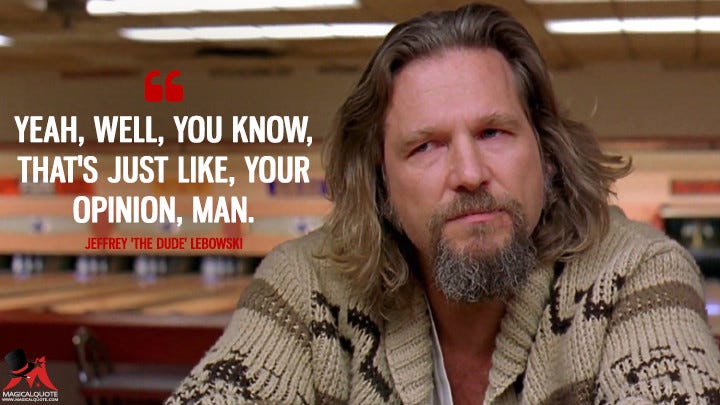
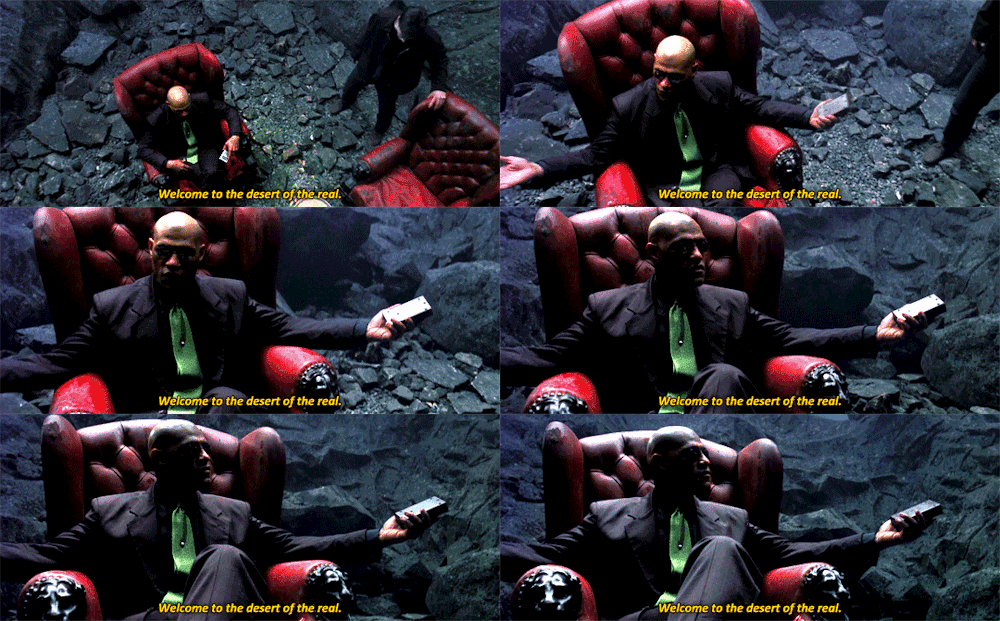
While Millennials adopted the affectation of irony in order to hide real insecurities (“lol I’m so fat tee hee”/”erm… I’m depressed lol”); Zoomers were born into the nihilism of perpetual irony. Gen X, having no desire to push goals onto their children because that would make them authoritarian, tended to give their children no guardrails. They were permitted to do as they wished insofar as it was cool. Older Zoomers will probably recall how much power Tony Hawk had over their early years. The “Dad Rock” of the fathers of the Zoomers (Gen X) consists of Primus, Tool, the Beastie Boys, and Pearl Jam. I once saw a Gen X dad begin to headbang when the organ began to play at a Catholic wedding. A constant piece of advice one would hear from Gen X’ers was to “find your Zen” which is essentially equivalent to:”do whatever makes you happy, man.” Essentially, Zoomers grew up in a waste land without any real direction. The fragments they encountered urged them in certain directions toward the desert of the Dude, and some warned them against the inevitable dangers of being a corporate slave (Office Space), but because Gen X was directionless, they could offer no real direction.
The Gen X parent is the Dude. The Dude is just Ferris Bueller grown up. They believe that life is meaningless and just do whatever their instincts prod them to do. As long as it’s fun and doesn’t really hurt anybody chill out and enjoy the ride, man. Growing up in California, Gen X parents tended to have lots of eastern religious paraphernalia. They were fine with their children hooking up and doing drugs as long as they weren’t driving. Certain parents had idiosyncratic authoritarian streaks usually related to being a dirty hippie. Not permitting children to eat meat, not permitting their children to wear makeup, not permitting their children to use deodorant, etc. Some parents were fine with nihilistic and sexual comedies but despised any depictions of violence altogether.
The central point here is that Gen Z was raised by a generation characterized by “living outside of the system, man.” This obviously created a new kind of system defined by its rejection of the previous system. Therefore, the Gen X system is contingent on what came before and can only exist as a refutation of that system. The defining characteristics of Gen X were rebellion, nihilism, and irony. Its emphasis on perpetual rebellion, lack of belief in anything beyond the self, and an inability to directly critique anything (hiding behind irony) made the Gen X system incapable of sustaining itself. These are the waters which defined Gen Z and determined its early behaviors.
Enculturation of Critique
This part may include a bit of self-indulgence. Zoomers enjoyed their childhood in the early 2000s. They were also the first generation to truly be defined by the internet. Therefore, when they started to become sentient in the 2010s and began to seek out their own forms of entertainment, they found what was most popular at the time (at least this is what I found): Ranters, reviewers, and critics.
This defined the internet of the 2010s, and for good reason. By the time the Zoomers were sentient, there was so much culture to catch up on, that they needed it to be filtered for them by the most intelligent reviewers available (Like Doug Walker). You didn’t have to sit down and watch a two-hour movie; you could watch someone else review the best and worst parts of three or four movies in the same time period. You didn’t need to develop your own opinion either, you could sound cultured and critical just like your Gen X parents without having to waste time actually reading, watching, or listening to anything in full. In a waste land of fragments, you now had a guide to show you what was and was not cool. You had status.
This era was defined by the generation one step older than the Zoomers, the Millennials. As Russell Walter adequately described in OK Zoomer, the Millennials rejected status defined by wealth in favor of status defined by taste because Millennials could not afford anything.
For the hipster, every aspect of cultural life became an arena for status competition. Music, especially, was subject to a taste hierarchy. Nowhere was this taste hierarchy more ruthlessly codified than at Pitchfork Media, the indie music publication. Pitchfork became the ultimate arbiter of what was ‘authentic’ (that much-beloved Millennial adjective) and what was vapid, cliché, cookie-cutter.
Zoomers were just becoming aware of taste when the hipster Millennial was at his penultimate peak. The most consumable form of hipster culture for a Zoomer on the internet was the hipster culture of critique. There was entertaining criticism to enjoy on all sides of any subject. The feminist reviewing video games to show how sexist they were (I was shown these videos by teachers in high school after having discovered Sargon of Akkad. I was probably insufferable), Anthony Fantano reviewing the newest authentic and powerful rap album, Doug Walker doing his iconic high pitch scream while reviewing Casper the Friendly Ghost or something. On the other side you had Sargon of Akkad reviewing Anita Sarkeesian reviewing a video game, or if you were really in the know you could watch Devon Stack (Black Pilled) review Forrest Gump. You could fill hours with content that made you feel superior to others on account of your greatly improved taste. Millennials found the words and had sufficient motivation (inability to progress in the status hierarchy) to seriously critique the status quo that Gen X could only ironically jab at. Gen X still sort of wanted to climb the ladder in the end, but Millennials never had that opportunity. The capacity for verbose critique authored by Millennials gave Zoomers a powerful capacity to become a general nuisance and a spiteful little creature. Russel Walter rightly praises taste in his essay, but when taste is filtered down to the mind of an 11–15-year-old Zoomer, taste just means being an asshole.
The Pains of Post-Irony
Russell Walter wrote an excellent article on taste and Millennial culture. Nonetheless, I was genuinely surprised by the Neo-Passeism guest he had on the Chudstack Review. This character was a perfect encapsulation of the above. Taste taken too far; taste purely for taste’s sake. It is in reaction to this that caused the Zoomer to become post-ironic. The Neo-Passeism article on marriage was especially perplexing to my Zoomer mind.
The arrogance of someone who marries a High-School Sweetheart is a conduit for pain. It is a metal rod in a meadow. If you play poker, you will understand the hopelessness of the “one-outer,” where only one card can save you from a loss, at less than 5% equity in the hand and chance at the pot. These shallow odds almost never hit, but when they do, people flip out, because everyone at the table understands how steep those chances are. The possibility of you finding someone with whom you would have a happy marriage within your homeroom is orders of magnitude less likely, yet you who push on it are legion. If you engaged in this kind of smooth-brain thing, it says is that you are a coward, willing to believe just about anything, and unable to venture past the teacher’s desk, much less the door to the building, or [G]od forbid looking outside the State or the Nation.
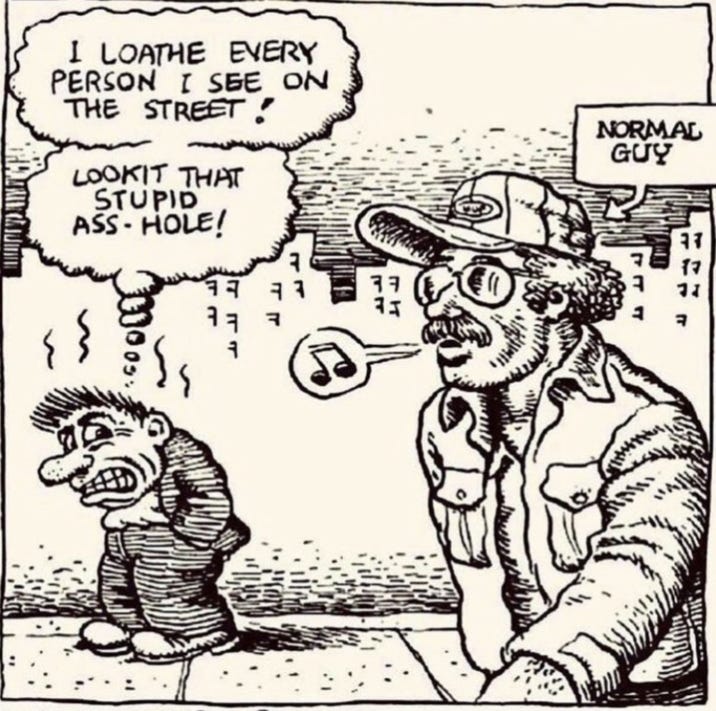
The essay is filled with the standard Gen X and Millennial critiques of marriage. Infrequent and lackluster sex, people only have children to keep their marriage going, people only stay in marriage out of a sunk-cost fallacy, etc. I looked into the authors of this piece and found that the principal figure is a skinny whoremongering passport-bro who lives in Japan. I did not like this piece. This article disappointed me because its authors claim that they are trying to bring about a new art movement, but this art movement isn’t new at all, it’s just a re-packaged version of Millennial taste-status. It is an old form that has been left behind by the Zeitgeist, it is passé if you will. It is the image below with a fresh coat of paint.

The Zoomer grew up in a world full of criticism and irony. Everything is subject to intense criticism from the whole world. So, what happens when the Zoomer finds something he actually likes? What if the Zoomer wants to write music? The prospect of sincerely presenting to the world something that one has spent years working on, only for it to be torn to shreds, is a terrifying one. Luckily, one could instead present everything insincerely. In the twenty-teens, there were plenty of great examples of this. Filthy Frank may be the best one. Instead of having to write good music, Frank was able to write stupid and vulgar music for fun while working on real music in secret (not that I would actually listen to Joji).
The other aspect of this was political. Cancel-Culture was in full swing in the twenty-teens. One could ruin their entire life by saying the wrong things to the wrong person. Therefore, it was easier to say everything as a joke and maintain constant plausible deniability. The risk to reward ratio made post-irony the safest bet. You could do anything as long as you did everything as insincerely as possible. In reference to the photo above and the question of marriage, a Zoomer would address these criticisms by saying: “marrying your college sweetheart and beating her is based and good for you marriage.” Is he serious? Is he joking? No one knows! I have never read Hegel and probably would not understand it if I did. Nonetheless, I will make a Hegelian comment on this subject. The thesis of the boomer status hierarchy met with the antithesis of irony. The synthesis of these created a new status hierarchy based around taste/criticism. The antithesis of this status hierarchy is an attack upon its foundations by an absolute defense to any and all criticism: post-irony. The hope I have, motivated by Morgoth’s article, is that the new Zeitgeist and synthesis of the above will be an age of sincerity.
The Age of Sincerity
Irony makes it impossible to live life well. Until one takes the step out of post-irony into sincerity, every action will be half-assed. A post-ironic existence is an existence characterized by a fear of critique. Believing in something is dangerous, because if it fails, the believer is shown to lack judgment. The new sincerity is a daring step: a choice to believe in opposition to the idea that belief acts upon us. The new sincerity is akin to Pascal’s wager, but a wager on our entire civilization. With the new sincerity, we can reincorporate our history instead of shunning it. This path was show to us by T.S. Eliot in the Waste Land.
The best modernist poets, like Eliot, wanted to recontextualize our lives so that we could live in history and not apart from it. As Scruton says: “For Eliot and his colleagues [] there could be no truly modern art which was not at the same time a search for orthodoxy: an attempt to capture the nature of modern experience, by setting it in relation to the certainties of a live tradition.” Ezra Pound wrote that the goal of modern poetry is to “make it new.” Ezra Pound was the main editor of the Waste Land, and the poem is dedicated to him. He was also the most important critic to come out of the early modernist movement.
Eliot’s goal in this poem is, as Scruton says, to make ourselves “at home in the world [] by acknowledging our fallen condition.” John Senior, a Catholic critic of the modernist poets, also says that the Modernists were disgusted at the world and their only desire was to destroy it. He is half right; the modernists were disgusted at the world because they saw what it was becoming. Eliot, almost like a prophet, saw that the depressing image of the barren waste would define the world to come.
Scruton states that Eliot’s poem demonstrates to us the soullessness of the modern city through juxtaposition with the beautiful scenes and allusions to all those things which the city denies us. The Waste Land is a thesis statement of modernist poetry. A collage of original work, numerous allusions, and quotes, it is a world of broken images and fragments which Eliot shores against the ruins of modernity. Eliot is trying to make sense of the modern world by pulling from myths and themes of the past. This is the path forward into sincerity.
The charlatan Madame Sosostris hands us the themes of the Waste Land from her pack of cards. The first of the four themes, and the one which Eliot most directly references, is the Fisher King Myth. The Fisher King is represented by the man with three staves. The Fisher King myth is mostly pulled out of From Ritual to Romance by Jessie Weston which Eliot himself references in the notes to the poem (which should be read as part of the poem). The second theme is the myth of Tiresias and broken sexual relationships. This is represented by Belladonna, the beautiful lady who takes the same name as the deadly plant nightshade. Tiresias, having been both male and female in Greek myth, foresuffered all of the brokenness in modern sexuality, and therefore is the perfect vehicle for exploring the wounds of modernity which so thoroughly segregates male and female. The third theme is the Drowned Phoenician sailor or the one-eyed merchant, as the two characters become essentially interchangeable. This is one of the more difficult themes to pursue as Eliot layers these themes in more obscure references than the rest. However, it seems to most directly deal with death and cyclical existence. The cyclical existence is represented by the wheel. The final and most important theme is that of Christ, spring, and rebirth. Christ is represented by the hanged man, who Sosostris cannot see. This is likely because the poem is simultaneously taking place immediately after the death of Christ, and in the modern world where our faith has faltered.

Parzival
The poem is written within a fisher king grail myth structure. Here, it seems we take the place of the kind stranger Parzival. The story of Parzival is the greatest telling of the Fisher King myth, and Eliot quotes both Wagner’s and Verlaine’s retelling of this myth throughout. The most important parts of this myth are that Parzival, a kind but foolish knight, comes across the “Fisher King.” This King was struck with infertility because he was seduced by a woman whom God did not intend for him to marry. Thus, he sits by his lake fishing, awaiting his savior. Because of his personal inability to bring anything new from himself, his lands around him become barren as well. In order to restore the king’s fertility, a stranger (Parzvival) must ask a specific question of the king when he sees the glamor of his palace and the ceremonies within, but he does not ask. He is therefore doomed to wander the waste lands for years until he may once again find the King and restore his fertility through purification using the Holy Grail, The Lance of Longinus, or both. Parzival also rescues Lady Cundrie from the enchantment of the wizard Klingsor. Klingsor made Lady Cundrie seduce the Fisher King. Because Parzival is able to resist seduction, Lady Cundrie is freed and she thanks him by washing his feet and drying them with her hair, like Mary of Bethany. This symbolism becomes very important later in the poem. The stranger is then required to travel through the “Chapel Perilous,” a dangerous enclosure which impedes the stranger from reaching their goal by shaking their faith. It seems to me that Eliot plays the Fisher King in this poem, and the stranger is played by many other characters.
The Fisher King is seen sitting on the banks of a river throughout the poem. He muses over the fleeting sexual relationships that occurred between the nymphs and the young rich men on those very banks, the young men leaving the women with fake names and addresses. He muses over the woman prostituting her daughter in the city, most likely without consent, given the nightingale song which follows. He muses on the sufferings of his father and brother, presumably doomed to fish the same rat-infested banks as he does now, their skeletons now laughing at him. The banks are filled with death and leave no sign of the sexual relationships which recently occupied them. Sex offers no offspring in the wastes; it is all infertile. Sex here is pursued for no reason beyond the selfish personal satisfaction it may bring. Hedonism is no way out.
In the land’s which used to be the Fisher King’s kingdom, there is nothing. Whenever we are in the Waste Land, the poet speaks to us, almost as if we are Parzival, wandering through the land in search of salvation. We, as the stranger, wander through it, knowing only a heap of broken images. Just as in the story of Parzival, we are greeted by different prophets, some of them trustworthy and others less so. We know only bits and pieces of the past. Every story is difficult to understand because it is a blurred and bizarre collection of many characters playing the same parts. For example, the story of the typist and the clerk is a broken version of the story of Parzival and Cundrie. Rather than Cundrie attempting to seduce Parzival, and Parival protecting the chastity of his heart, the clerk takes advantage of the typist’s empty and emotionless state to get the only thing he wants from her and then quickly leaves. Instead of the humble act of drying Parzival’s feet with her hair, the typist is left even emptier than before, only happy that it ended so quickly.
Finally, after wandering through the endless Waste Land, empires crashing around us and the demonic hordes of the revolution swarming like hornets, we come to the Chapel Perilous. Surrounded by the graves of those who could not make it through, we resolve ourselves with the fact that bones cannot harm anyone and push through the Chapel. Only when we have taken an act of faith does the rain begin to flow from the sky heralded by cracks of thunder. The King, finally healed, reveals the fruits of his musings. The first is absolute charity, total giving of the self in action and not passively as with the typist or the hyacinth girl. The second is empathy and communication, which could cost us our lives. However, if we do not communicate, we are forever trapped in a prison cell, starving for genuine connection. The last is self-control. If we control ourselves and are not ruled by wild passions, we may avoid the fate of the Phoenecian sailor. The king’s message is that only by clearing ourselves of fear and giving totally of ourselves out of love may we finally be reborn out of the waste land. The insincerity bred by fear can only be healed by radical trust and faith in others.
Tiresias
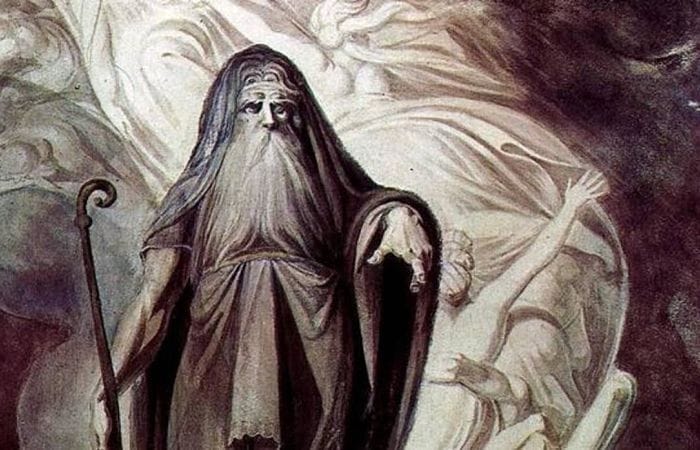
Tiresias, the Greek mythological prophet who was cursed to spend much of his life as a woman, only returning to manhood after having an entire family, is central to the sexual relationships within the poem. After returning back to manhood, he was asked by Zeus and Hera which sex enjoyed the act of making love more, and Tiresias responded that women do. Hera cursed him with blindness and Zeus blessed him with prophecy. Within the Waste Land, all men share in one story, and all women share in another story. Tireseas exists as man and woman, experiencing both stories at once. The sexual relationship between the typist and the clerk is the most closely observed by Tiresias. The sexual relationship in this scene is empty. The typist is too dead inside to care about what is done to her and is only happy when it has ended. The clerk is too dead to care how it affects his prey. She has had something taken from her and offered little to no resistance.
The story the prophet tells us about the Hyacinth Girl is another form of a broken relationship. The German words above and below this section are taken from Wagner’s Tristan and Isolde. The German above the Hyacinth Girl :“fresh blows the wind toward home, my Irish child, why do you tarry?” and below “empty and desolate is the sea” are a juxtaposition of a mundane and sorrowful scene with the tragedy and drama of Tristan and Isolde. His purpose here is to explore the despair of modernity, in that our greatest personal dramas bear little resemblance to the dramas of the past. Tristan and Isolde are deeply in love due to the accidental ingestion of a love potion and have an intense affair under the nose of the King, living as lovers only by night. The two lovers are separated and eventually die, leaving the king to grieve the death of his friend and the woman he loved, only discovering the existence of the potion too late. This is the fear that the prophet shows us. In the Waste Land, our Tristan and Isolde are pale copies of the same characters playing out the same stories. Even our tragedies are empty and free from any real drama because we fear sincerity. Instead of this intense affair, the man cannot speak to the Hyacinth girl because he is empty. No matter how much she encourages him, he is an interior waste land. Tireseas lives this too.
In “A Game of Chess,” we witness more brokenness. The title is a reference to a book which was then popular that depicted courtship as a game of chess. The first words are directly ripped from Antony and Cleopatra, alluding to the wealth of the players and the direction their relationship is heading. The painting on the mantelpiece depicts the change of Philomel. Philomel was imprisoned and raped by king Tereus who cut out her tongue to prevent her from telling anyone. Philomel then made a tapestry which she sent to her sister, depicting the rape. The sister then rescued Philomel. In vengeance, the sisters killed the king’s son and made him into a stew for the king. The king, enraged, pursued them, and the three were then changed to birds. Philomel is turned into a nightingale, singing “Jug Jug Jug” forever more. This song should conjure up those images of this story whenever repeated within the poem.
The scene which follows is extremely mundane in comparison. It is a discussion between an extremely anxious woman, and her husband. The man here knows and feels nothing, just like the man with the Hyacinth girl. He feels that this relationship is lost in the wastes, “in rats alley where the dead men lost their bones.” Near the end of this scene the man reveals that he is waiting for a knock at the door to end their game of chess. This might be interpreted in two ways, either he is waiting for death to take him so that this relationship might finally end, or he is waiting for his fertility to be restored by the kind stranger arriving at his door. The next scene reflects this same theme of death and infertility ever present in the insincere.
The woman talking at a closing bar, frequently interrupted by “HURRY UP PLEASE IT’S TIME” is exploring more deeply the story of Philomel. The woman is explaining a conversation she had with a friend. She explains how she has to artificially beautify herself to make her husband happy, and that she takes pills that abort her babies because she wants to continue to satisfy her husband. She expresses that her husband will go elsewhere if she doesn’t. This kind of broken, infertile, and murderous relationship is what defines relationships in this world of insincerity. The section ends with a quote from Ophelia in Hamlet, the words she said during her suicide. The point of the entire second section is that the relationship of convenience, the relationship which does not ascend beyond sex, is a murder-suicide. The children are murdered for convenience, and the relationship dies with them. The man rapes and the woman murders. Tireseas sees all and suffers all.
The songs of the water nymphs at the end of the Fire Sermon are in reference to these kinds of relationships. The first nymph sings a song of lust, and how it has carried her away from home. The second sings of her lovers’ infidelity, and how her emptiness makes it impossible to care. The last nymph sings about the feeling of emptiness she bears. She expects and desires nothing, she feels nothing. Irony and critique protect them from wanting more, but as punishment all they can do is suffer without hope. After their songs are concluded, Eliot quotes Augustine. First, he comes to Carthage, as a slave to lust, and then begs for God to pluck him out. At the end of the poem, Eliot quotes Dante, referencing the scene wherein Arnaut willingly steps into the fire to be cleansed of his lust. Eliot shows us that in order to be free from lust, we must be willing to accept suffering. If we are not willing to step out from the protective curtain of irony out the fear of being let down, we will never have the ability to hope.
The Phoenecian Sailor/The One-Eyed Merchant
The tale of the Phoenecian Sailor or the One-Eyed Merchant is a warning. This character shows up less frequently than the others. This character lacks control. He is a slave to mammon, and because of this he drowns on his journey. Those who are slaves to the material can never be freed from it and are doomed to repeat forever the journey to and from work, until their bodies become one with the ocean and they are lost to the sea. The undead walking across London bridge and the men walking around in circles are all the Phoenecian Sailor, endlessly searching for satisfaction where it does not exist. Eliot’s answer to this is self-control. Eliot tells the merchants to seek beauty in the Ionaian columns of white and Gold. Those who only hope for material wealth will end up as the One-Eyed Merchant. For the Drowned Sailor, there is no baptism in the water, there is just rebirth again as the same merchant at another time. The merchant cannot be reborn as long as he is a slave to mammon.
The Hanged Man
The Burial of the Dead begins with a juxtaposition of April and cruelty. April, the month of rebirth, the resurrection of Christ, is a painful event. This period is cruel as it stirs those feelings we would rather have left sleeping, and which the winter allowed us to bury. But, rebirth requires death, as Christ demonstrated to us most beautifully and perfectly in His passion. The corpse we have planted in our garden cannot grow unless we have buried it and left it undisturbed, just as during lent we learn to miss the presence of Christ. This theme reaches its conclusion at the end of the poem. What the Thunder Said begins with a reference to Christ’s passion, and it is revealed that the men wandering through the desert are Christ’s apostles. Here their faith is shaken as they are mocked by the men living in the mountains. They are taunted by the sound of dripping water, but there is no water. It is just the sound of the thrush, a bird which represents monogamous relationships, taunting them. But then, there is a third one beside them, who they cannot recognize. This is Christ. Just at the moment when their faith was lowest, when all seems lost, Christ returns. The only salvation from the waste land, the only one who can bring the rain is Christ. We must hold on to faith until that rain comes. Though death is painful, there is the hope of rebirth in Christ. Here the epigraph of the poem finally reveals its meaning. Why does Sybll want to die? She has lived too long, she has decayed. Because she cannot die, she cannot be reborn. If we accept our death, we may be reborn in Christ, rather than repeating the failures of the merchant for eternity.
Irony and critique are cowardice. The future can only be faced with the dumb, baby-faced hope of Parzival. Yes, we will die, we will be betrayed, we will be hurt; but if we cannot sincerely face that and fully embrace our foolish hopes in spite of the dangers, we will have no future. We deserve the barren wastes. Let yourself be foolish and full of hope.